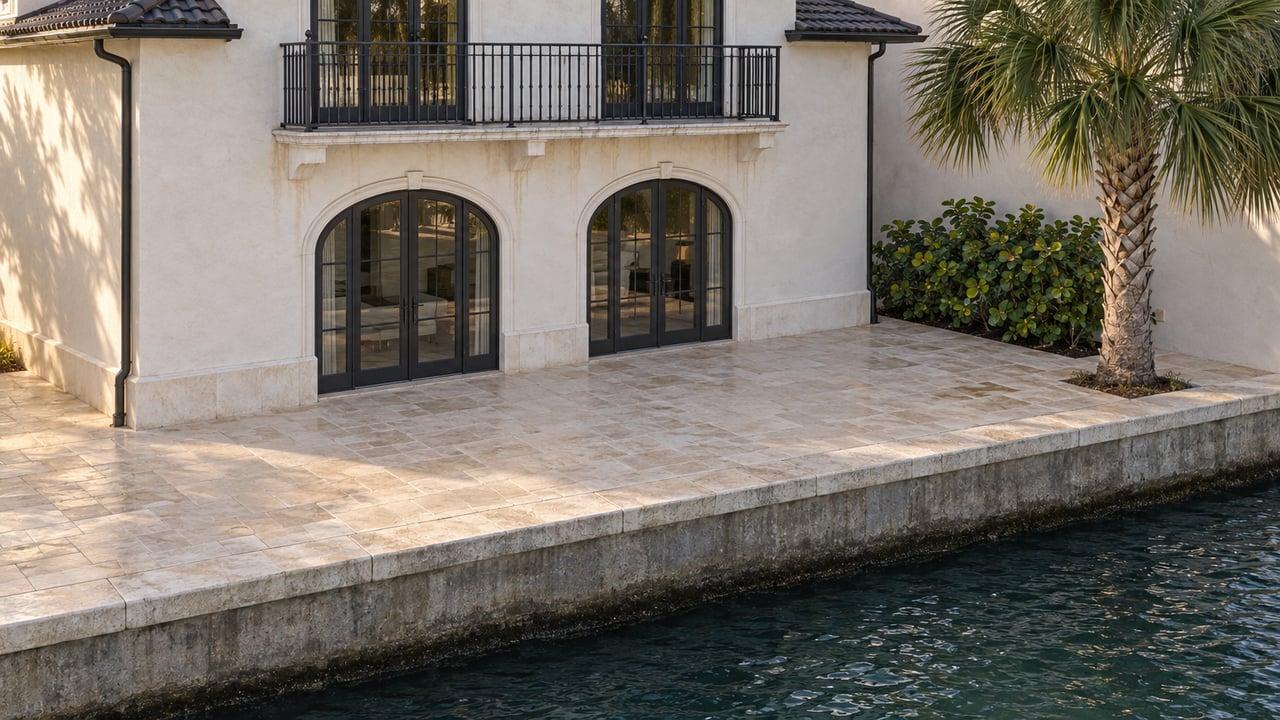
A homeowner near Hatchett Creek called her contractor in August 2026 to replace a few storm-damaged fence panels. She had read that Florida no longer required permits for small residential jobs, so she expected the cheapest, fastest version of the project. The contractor pulled up the property on the flood map before quoting the job. The address sat inside a mapped Special Flood Hazard Area, as defined by the Florida Building Code. The new exemption did not apply under HB 803. She needed the same permit she would have needed a year earlier.
That conversation is playing out across Venice this fall, and it traces back to a state law that took effect on July 1, 2026.
What HB 803 Actually Changed
Governor DeSantis signed HB 803 into law in the spring of 2026, and the bill created two new permit exemptions for single-family homes. The first covers minor work valued under roughly $7,500. The second covers the voluntary installation of temporary hurricane and flood protection walls or barriers. The Florida House of Representatives bill summary frames the law as a response to permitting delays and fees that were slowing routine repairs and small construction projects statewide.
The City of Venice Building Department has already posted its own HB 803 policy, confirming the exemption is live locally and outlining how residents request it.
The headline sounds like a clean win for anyone planning a small project this year. The fine print decides who actually gets it.
The Condition That Overrides Everything Else
Both exemptions carry the same disqualifier: they do not apply to any property located partially or entirely within a Special Flood Hazard Area, the FEMA-mapped zones where the risk of storm surge or flooding is highest. Cities implementing HB 803 across the state have been blunt about how much of their housing stock this removes from eligibility. Cape Coral's building department noted that more than 60 percent of that city sits inside a mapped Special Flood Hazard Area, which means the exemption will not apply to most projects there regardless of cost or scope.
Venice has not published its own version of that percentage, but the underlying geography works the same way everywhere on Florida's Gulf Coast. Flood zone designation tracks proximity to open water, canals, and low elevation, and Venice's identity is built on exactly those features. Venice Island, the historic downtown core, and the canal-front neighborhoods that define the city's older housing stock all sit close to Roberts Bay, the Intracoastal Waterway, or a dredged canal. Those are the same waterways that pull a parcel into a mapped flood zone in the first place. A homeowner cannot assume either way. The only way to know is to check the specific parcel against FEMA's map.
Here is what qualifies for the minor-work exemption, and what disqualifies it:
| Condition | What it means in practice |
|---|---|
| Total project value under about $7,500 | |
| No electrical, plumbing, mechanical, or gas work | Excluded regardless of cost |
| No structural work | |
| Single-family dwelling | Multifamily and commercial property do not qualify |
| Property entirely outside a Special Flood Hazard Area | If any portion of the lot falls inside the SFHA, the whole project loses the exemption |
| Written exemption request filed before work begins | The city still requires notice, even when no permit is issued |
That last line matters as much as the flood zone rule. This is not a law that lets homeowners skip the city altogether.
What Still Needs a Permit No Matter Where You Live
Even for a Venice property that sits entirely outside a flood zone, the exemption only covers a narrow slice of home improvement work. Structural items are excluded outright. Any electrical, plumbing, mechanical, or gas component removes the exemption too, which rules out most kitchen and bathroom work of any real size. What is left is a fairly small category under the dollar threshold.
For a property inside a flood zone, none of that matters. The permit requirement stays exactly where it was before July 1.
The Paperwork Doesn't Disappear, It Changes Shape
Even a project that clears every condition still requires a written exemption request submitted to the city before work starts. The homeowner or contractor has to document the scope and value of the work in advance. Splitting one larger project into smaller pieces to stay under the $7,500 threshold is explicitly prohibited under the law. A homeowner who breaks a $12,000 renovation into three invoices to dodge the rule has not created three exempt projects. They have created one unpermitted project.
Venice's own floodplain management rules add a second layer for anyone doing meaningful work inside a flood zone. The city's Substantial Improvement rule, often called the 50 percent rule, requires a property owner to bring a structure into full flood compliance, including raised electrical components and elevation adjustments, once the cost of repairs or renovations reaches half the building's market value. That rule exists independent of HB 803 and applies regardless of whether the new exemption would otherwise have covered a smaller version of the same project. Flood zone properties in Venice are not just excluded from the new exemption. They remain subject to a separate, more demanding threshold the moment a renovation gets large enough to matter.
What This Means If You're Buying or Selling in Venice Right Now
For a seller with recent exterior work, the timing question is worth asking directly. Any fence repair, cosmetic update, or small project completed after July 1, 2026 should have either a standard permit on file or a written exemption request filed with the city, assuming the property qualifies at all. A buyer's inspection or a title search will not automatically flag the difference between properly exempted work and simply unpermitted work. That distinction becomes the seller's or the buyer's problem later, typically during an insurance underwriting review or a future renovation permit application that surfaces the earlier gap.
For a buyer planning to renovate after closing, budgeting around the new law only makes sense once the parcel's flood zone status is confirmed. FEMA's Flood Map Service Center lets anyone look up a specific address before assuming a small project is exempt. A buyer eyeing a canal-front home in Venice East or a bungalow near the historic downtown should treat the exemption as unlikely to apply until the map says otherwise, not the reverse.
The dollar stakes of guessing wrong are real but not dramatic on their own. The bigger cost is not the fee itself. It is discovering after the fact that a repair was never properly authorized, at exactly the moment a lender, an insurer, or a future buyer is asking for documentation that was never filed.
Check the parcel before the contractor writes the quote. That single step decides which version of this law actually applies to the house.
If you are buying or selling in Venice and want to understand how a specific property's flood zone status and renovation history could affect your timeline or your budget, the Megan Finke Group can walk through it with you before you make an offer or list your home.
This article is general information, not legal, tax or financial advice. Consult a qualified professional about your situation.
